
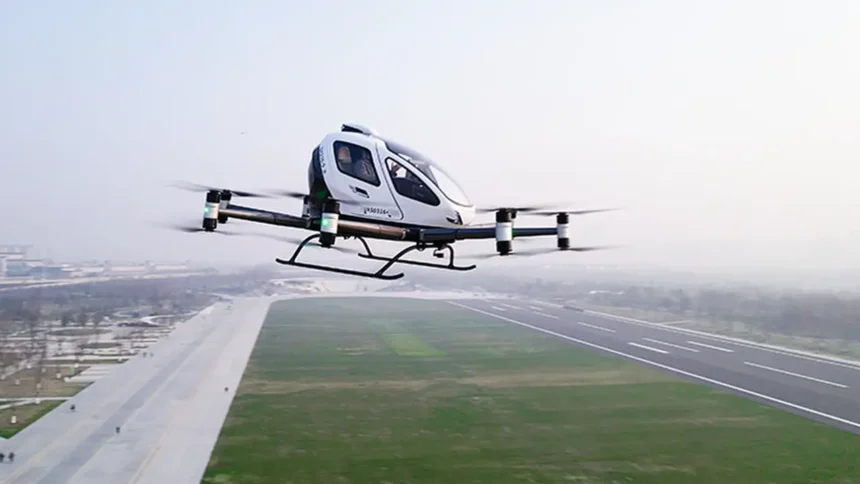
Traffic jams may soon become a thing of the past. In a breakthrough for urban mobility, the world witnessed the successful trial of a pilotless electric drone taxi, marking a major step towards futuristic air travel.
Successful Trial in Rwanda
According to a report in the South China Morning Post, the trial was conducted in Rwanda’s capital, Kigali, during a major Africa summit that brought together representatives from 34 countries. The electric drone taxi, developed by China’s EHang Holdings, successfully executed take-off and landing, proving its capability for safe passenger transportation without a pilot.
China and Rwanda Partner on the Project
The trial was carried out in collaboration between the Rwandan government and China Road and Bridge Corporation. In a statement on Facebook, the Rwandan government said the purpose of this partnership was not only to showcase cutting-edge aviation technology but also to strengthen Rwanda’s position as a hub for innovation in Africa.
Why Rwanda?
Rwanda, a landlocked nation with no direct access to the sea, faces logistical and trade challenges due to its geographical position. With a population of around 14.2 million, the country is now focusing on tourism and advanced transportation solutions to boost its economy.
Developing air mobility options like drone taxis could help reduce urban congestion, cut air pollution, and create modern infrastructure that attracts investment and tourism.
The Future of Air Mobility
The success of this pilotless electric drone taxi has global significance. While drones have already proven their effectiveness in surveillance and even warfare — most notably in the Russia-Ukraine conflict — this latest development highlights how drone technology is evolving into commercial passenger transport.
If adopted widely, electric drone taxis could transform urban commuting worldwide, offering faster, cleaner, and more efficient alternatives to road travel.