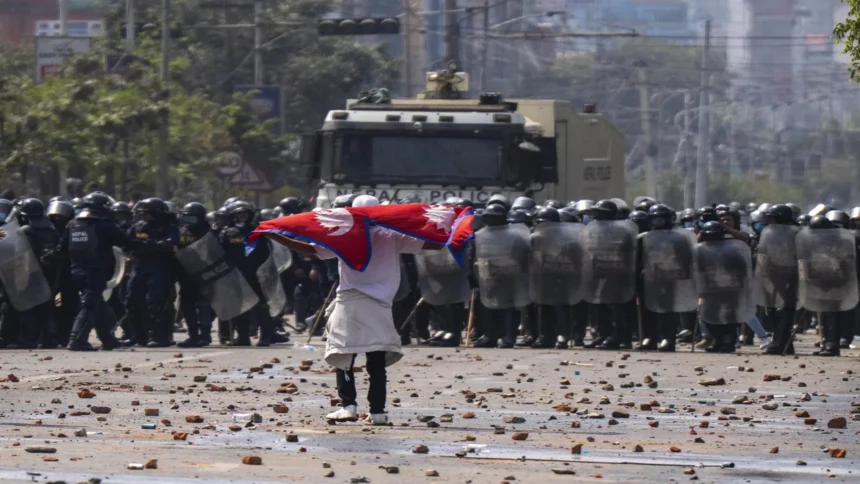
Nepal is witnessing a massive wave of protests after the government banned 26 major social media platforms, including Facebook, X (formerly Twitter), WhatsApp, and YouTube. What began as an online campaign has now spilled onto the streets, with thousands of young people — largely from Generation Z — clashing with security forces in Kathmandu.
The demonstrations, now being dubbed the “Gen Z Revolution,” turned violent on Monday near the Parliament building. Police fired tear gas, used water cannons, and opened fire on protesters who tried to break barricades. One person was killed and more than 80 others were injured in the clashes. Authorities later imposed a curfew in sensitive areas of the capital.
Why Did Nepal Ban Social Media?
On September 4, the Oli government announced a blanket ban on 26 social media and communication platforms, citing non-compliance with national regulations. The Ministry of Information and Communication said that companies had failed to register locally, appoint grievance officers, or establish official contact offices in Nepal.
While the government maintains the move is purely a regulatory step, critics and opposition leaders allege it is an attempt to silence dissent and curb free expression.
Students Lead the Movement
The ban has triggered outrage among Nepal’s youth. Thousands of students in school and college uniforms poured into the streets, waving flags and carrying placards that read, “Our free voice is our right” and “Where is the taxpayers’ money going?”
Despite internet restrictions and mobile network blackouts in some areas, protesters used alternative platforms like TikTok and Reddit to organize and amplify their movement.
Parliament Turns Into Flashpoint
The most intense clashes occurred outside Nepal’s Parliament. Protesters broke through barricades, and some even managed to enter restricted zones before being repelled by security forces. Viral videos show clouds of tear gas, protesters hurling bottles and sticks, and police firing in response.
Anger Runs Deeper Than Social Media
Analysts suggest the unrest is not just about the ban but also a manifestation of long-standing frustration with corruption, unemployment, and widening economic inequality. The ban, they say, was the spark that ignited pent-up anger among digitally connected young Nepalis.
PM Oli Defends the Ban
Prime Minister K.P. Sharma Oli has stood firm, defending the decision as necessary to protect “national sovereignty and dignity.” Speaking at a party conference, he said, “The country’s freedom and honor cannot be compromised at any cost. The government will always stand against corruption and chaos.”
Companies Ignored Deadline
The government had earlier given major social media companies a deadline of August 28 to comply with local registration rules. None of the big players, including Facebook, Instagram, WhatsApp, YouTube, X, LinkedIn, or Reddit, submitted applications within the stipulated time.
By contrast, TikTok — which had faced a nine-month ban last year — officially registered in November 2024, thereby avoiding the latest crackdown. Viber and four other companies have also completed registration, meaning they will not face restrictions.
A History of Digital Restrictions
Nepal has a history of blocking digital platforms. In July 2025, Telegram was banned over concerns of online fraud and money laundering. TikTok too faced an interim ban in August 2024 before being reinstated after agreeing to regulatory conditions.
Platforms Currently Banned
The government’s ban covers 26 platforms, including Facebook, Instagram, WhatsApp, YouTube, X (Twitter), Snapchat, LinkedIn, Reddit, Viber, and Botim. TikTok remains operational for now, thanks to its earlier compliance with Nepal’s registration rules.